
The Fourth of July is one of America’s most meaningful holidays. It is a time for families, friends, and communities across Texas to gather for barbecues, fireworks, parades, concerts, and celebrations honoring the freedoms that define our nation.
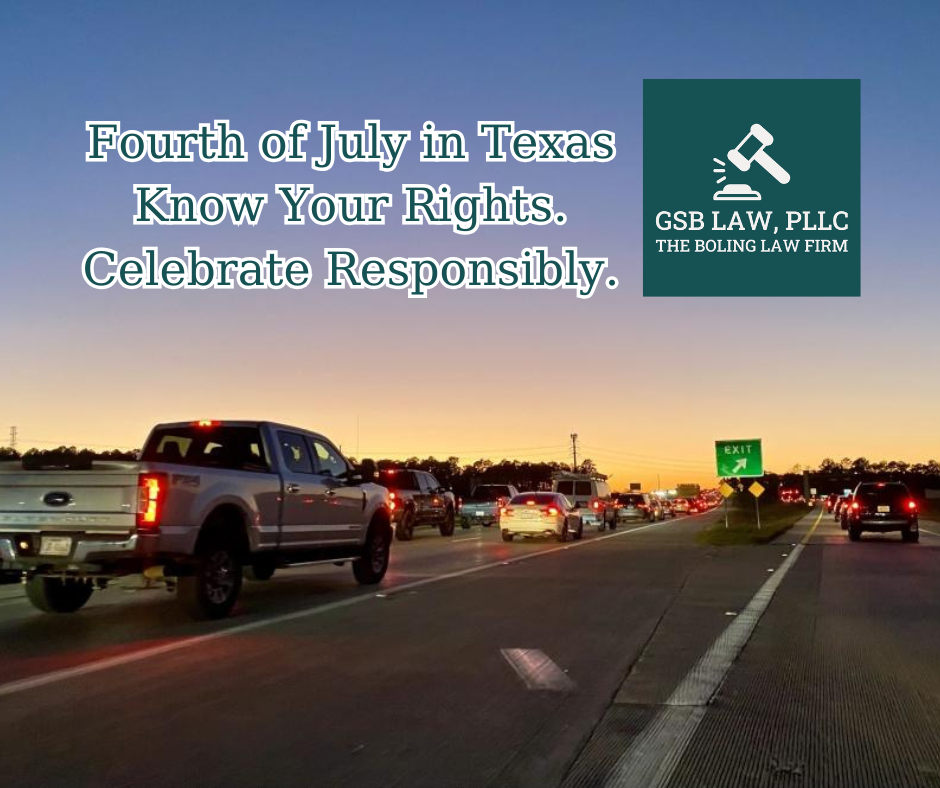
It is also one of the busiest travel weekends of the year. Millions of Texans are expected to travel over the Independence Day holiday, resulting in heavier traffic, larger public gatherings, and increased law enforcement activity across the state. Texas Department of Public Safety troopers traditionally increase patrols during the holiday to focus on impaired driving, speeding, distracted driving, seat belt violations, and other traffic offenses as part of statewide safety initiatives.
While public safety is an important priority, increased enforcement does not reduce your constitutional rights. Whether you are stopped while driving, questioned by law enforcement, or accused of committing a crime, those rights remain fully intact.
Increased Enforcement Means More Police Encounters
Holiday weekends naturally create more opportunities for interactions between law enforcement and the public. Officers respond to traffic accidents, large events, neighborhood celebrations, lake activities, and complaints involving alcohol or disturbances.
As a result, some of the more common criminal charges during the Fourth of July holiday include:
- Driving While Intoxicated (DWI)
- Drug possession
- Assault and family violence allegations
- Public intoxication
- Reckless driving
- Disorderly conduct
- Weapons-related offenses
- Fireworks violations where local ordinances apply
Being arrested does not automatically mean someone is guilty. Every criminal case deserves a careful review of the evidence, witness statements, police procedures, and the circumstances surrounding the investigation.
An experienced criminal defense attorney examines whether law enforcement followed the law, whether constitutional rights were respected, and whether the prosecution can actually prove its case beyond a reasonable doubt.
A Traffic Stop Does Not Eliminate Your Constitutional Rights
Many people become understandably nervous when they see flashing lights in their rearview mirror. Remaining calm and respectful is often the best course of action.
At the same time, it is important to remember that constitutional protections continue to apply throughout a police encounter.
Depending on the circumstances, individuals may have important legal protections that include:
- The right to remain silent.
- Protection against unreasonable searches and seizures.
- The right to consult with an attorney.
- The presumption of innocence.
- The right to challenge unlawfully obtained evidence in court.
Every situation is different, and exercising your rights should always be done respectfully and without interfering with law enforcement. Questions regarding whether officers acted lawfully are generally resolved later through the legal process rather than during the roadside encounter.
Increased DWI Patrols Do Not Mean Every Arrest Is Valid
The Fourth of July has long been associated with increased DWI enforcement throughout Texas.
Law enforcement agencies devote additional resources to identifying impaired drivers because alcohol-related crashes remain a significant public safety concern. However, increased enforcement does not change the legal standards officers must follow.
Police must still have lawful grounds to initiate a traffic stop. Field sobriety testing, chemical testing, and the collection of evidence must comply with constitutional protections and Texas law.
In some cases, evidence may be challenged because procedures were not properly followed, testing equipment was improperly maintained, witness testimony is inconsistent, or other legal issues exist. Every DWI case should be evaluated based on its individual facts rather than assumptions.
Think Carefully Before Posting on Social Media
One mistake many people make after an arrest or police encounter is immediately discussing the incident online.
Photos from parties, livestreams, text messages, videos, and social media posts may later become evidence in a criminal investigation or prosecution. Even statements intended as jokes can be taken out of context.
If you become involved in a criminal investigation, it is generally wise to avoid discussing the incident publicly until you have spoken with your attorney.
An Arrest Is Only the Beginning of the Legal Process
Many people mistakenly believe that being arrested means they will automatically be convicted.
That simply is not how the criminal justice system works.
Every criminal case involves numerous stages where evidence can be challenged, constitutional issues can be raised, witnesses can be questioned, and prosecutors must prove every element of the offense beyond a reasonable doubt.
In some cases, charges may be reduced. In others, evidence may be suppressed or charges dismissed entirely. The outcome depends on the facts, the quality of the evidence, and the legal issues involved.
For that reason, it is important not to make assumptions based solely on an arrest.
Celebrate Independence Day Responsibly
The freedoms we celebrate on the Fourth of July also carry personal responsibility.
If your plans include alcohol, arrange for a designated driver, use a rideshare service, stay overnight where you are celebrating, or make other transportation plans before the festivities begin. Responsible decisions protect not only you, but your family, friends, and everyone sharing Texas roads.
If you or someone you know is arrested during the holiday weekend, remember that an accusation is not a conviction. Protecting your legal rights from the very beginning can have a meaningful impact on the outcome of your case.
At GSB Law, PLLC, we represent individuals facing criminal charges throughout Denton, Collin, and Tarrant Counties, as well as surrounding North Texas communities. Our goal is to ensure every client receives experienced legal representation, careful case evaluation, and a strong defense while protecting the constitutional rights that every person is guaranteed under the law.