
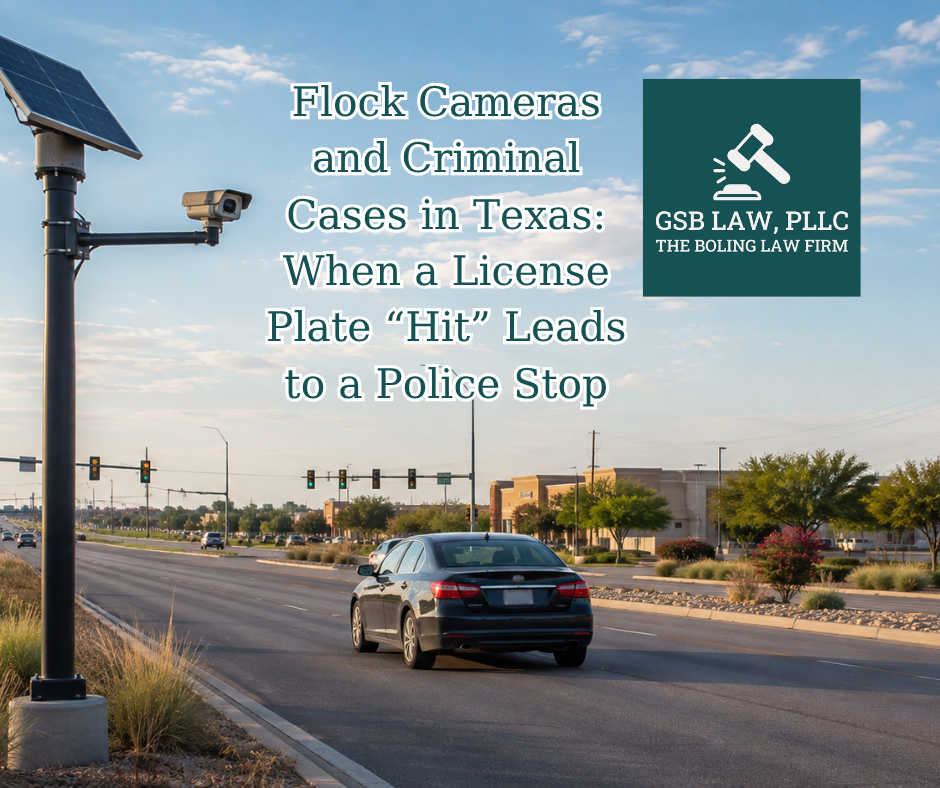
Flock cameras are becoming a familiar sight along Texas roads. These automated license plate readers can photograph a passing vehicle, read its license plate, record where and when it was seen, and save information about the vehicle’s make, model, color, and other visible features. Police can receive an alert when the system identifies a plate associated with a stolen vehicle, wanted person, or law enforcement investigation.
The technology can help officers locate a vehicle quickly. It can also place an innocent driver under suspicion because of an outdated alert, incorrectly entered plate number, computer misread, or unsupported assumption about who was driving.
When a Flock camera contributes to a traffic stop, arrest, or search, the resulting evidence should not be treated as unquestionable simply because it came from a computer.
Attorney Gregory Scott Boling is Here to Help! (940) 220-7080
How Do Flock Cameras Work?
Flock Safety cameras are a type of automated license plate reader, commonly called an ALPR or LPR. Unlike a traditional traffic camera used to issue a red-light or speeding citation, an ALPR is generally designed to collect and organize information about vehicles traveling through a particular location.
The system can compare a detected plate with a “hot list” containing plates connected to stolen vehicles, warrants, missing-person cases, or active investigations. An officer may receive an alert showing the plate, an image of the vehicle, and the time and location of the detection. Investigators may also search stored data to learn whether a particular vehicle passed other cameras during the applicable retention period.
A camera hit is an investigative lead. It does not necessarily establish that a crime occurred, that the plate was read correctly, or that the vehicle’s registered owner was behind the wheel.
Are Flock Camera Searches Legal in Texas?
The constitutional law surrounding automated license plate readers continues to develop.
In United States v. Porter, decided March 17, 2026, the U.S. Court of Appeals for the Fifth Circuit held that the limited use of license plate-reader data in that case was not a search under the Fourth Amendment and therefore did not require a warrant.
The court distinguished the occasional observations made by approximately ten roadside cameras from the extensive location history at issue in the U.S. Supreme Court’s cell-site location decision, Carpenter v. United States. The license plate reader recorded the vehicle only when it passed particular cameras on public roads. The Fifth Circuit concluded that those intermittent observations did not create the same comprehensive record of a person’s movements that long-term cell phone tracking can produce.
This decision matters in Texas because federal courts in the state are within the Fifth Circuit. However, Porter should not be read as unlimited approval of every automated surveillance program or every police action prompted by an alert. The court evaluated the particular technology, number of cameras, information collected, and facts of that case. A much broader system capable of reconstructing a person’s movements over time could present different constitutional questions.
The legality of obtaining the data is also separate from whether police had a lawful reason to stop a particular vehicle, detain its occupants, conduct a search, or make an arrest.
Does a Flock Alert Give Police the Right to Stop a Vehicle?
Police generally need reasonable suspicion that a crime or traffic violation occurred before stopping a vehicle. A Flock alert may contribute to reasonable suspicion, but the complete circumstances matter.
Important questions may include:
- What information generated the alert?
- Was the license plate entered and read correctly?
- Was the alert current, or should it have been removed?
- Did the camera image match the vehicle officers stopped?
- Was the suspected offense sufficiently described?
- Did officers confirm the alert through dispatch or another database?
- Did police know anything about the driver, or did they assume the registered owner was driving?
- Did officers observe an independent traffic violation?
An alert associated with a stolen vehicle may create a very different situation from a vague entry saying a car is “connected” to an investigation. Courts evaluate whether officers relied on specific, objective facts rather than an unsupported hunch.
Even when an initial stop is lawful, officers do not automatically have authority to search every part of the vehicle. The prosecution must still justify a warrantless search under a recognized exception to the warrant requirement, such as consent, probable cause, a lawful search incident to arrest, or the plain-view doctrine.
Flock Data Is Evidence, Not Infallible Proof
Automated systems can make mistakes, and human beings decide what information is placed into law enforcement databases. A partial, obstructed, temporary, damaged, or visually similar plate may contribute to a misidentification. Weather, glare, darkness, camera position, and image quality can also affect what a camera records.
Vehicle ownership presents another problem. A plate may identify the registered vehicle, but it does not by itself identify the driver. Family members may share a vehicle. A car may have been loaned, rented, recently sold, or used without the owner’s permission. A plate may also have been stolen or attached to a different vehicle.
Prosecutors must prove the elements of a criminal charge with admissible evidence. A timestamped image showing that a vehicle passed a camera does not necessarily prove who occupied the vehicle, where it went afterward, or what anyone inside knew or intended.
What Should a Criminal Defense Attorney Investigate?
When license plate-reader evidence plays a role in a case, the defense may need more than the image selected for the police report. Relevant records can include:
- The original image and associated metadata
- The precise plate number detected and the system’s matching information
- The location, date, and time recorded by the camera
- The alert, hot-list entry, or search terms used by law enforcement
- The source, age, and status of the information that caused the hit
- Dispatch recordings, officer communications, body-camera video, and dash-camera video
- Database access logs showing who searched the plate, when, and for what stated purpose
- Records showing whether other agencies supplied, received, or searched the data
- The agency’s ALPR policies, retention rules, audit records, and training materials
- Maintenance and performance information when reliability is disputed
This information can help determine whether police stopped the correct vehicle, whether the officer’s account matches the actual timeline, whether the detention became unreasonably long, and whether a later search or arrest had sufficient legal justification.
If officers violated the Fourth Amendment or applicable Texas law, the defense may file a motion to suppress evidence obtained as a result of the unlawful conduct. The available remedy will depend on the facts, how the evidence was obtained, and whether another legal doctrine applies.
Privacy Concerns Are Driving New Scrutiny in Texas
Flock cameras have recently drawn substantial attention across Texas. In August 2026, Governor Greg Abbott halted further state funding for Flock cameras amid concerns about privacy, access, and reported misuse. Some Texas communities have ended or reconsidered their contracts, while other law enforcement agencies continue to defend the cameras as valuable tools for finding stolen vehicles, locating missing people, and investigating serious crimes.
The public-policy debate does not decide whether evidence is admissible in an individual criminal case. It does, however, highlight the importance of knowing who can access the information, how widely it is shared, how long it is retained, and whether searches are properly documented and audited.
Charged After a Flock Camera Alert? Have the Entire Stop Reviewed
A police report may make a technology-assisted investigation sound automatic: a camera detected a plate, an alert appeared, and officers made a stop. The law requires a closer examination. Each step must be supported by reliable facts and lawful police conduct.
If a Flock camera, automated license plate reader, or shared law enforcement database contributed to your stop or arrest in Denton County or North Texas, speak with a criminal defense attorney promptly. Early investigation may be important because database records, video, and other electronic evidence can be subject to retention limits.
GSB Law PLLC represents people facing criminal allegations in Denton County and throughout North Texas.
Contact the firm to discuss the facts of your case and the evidence law enforcement intends to use.