
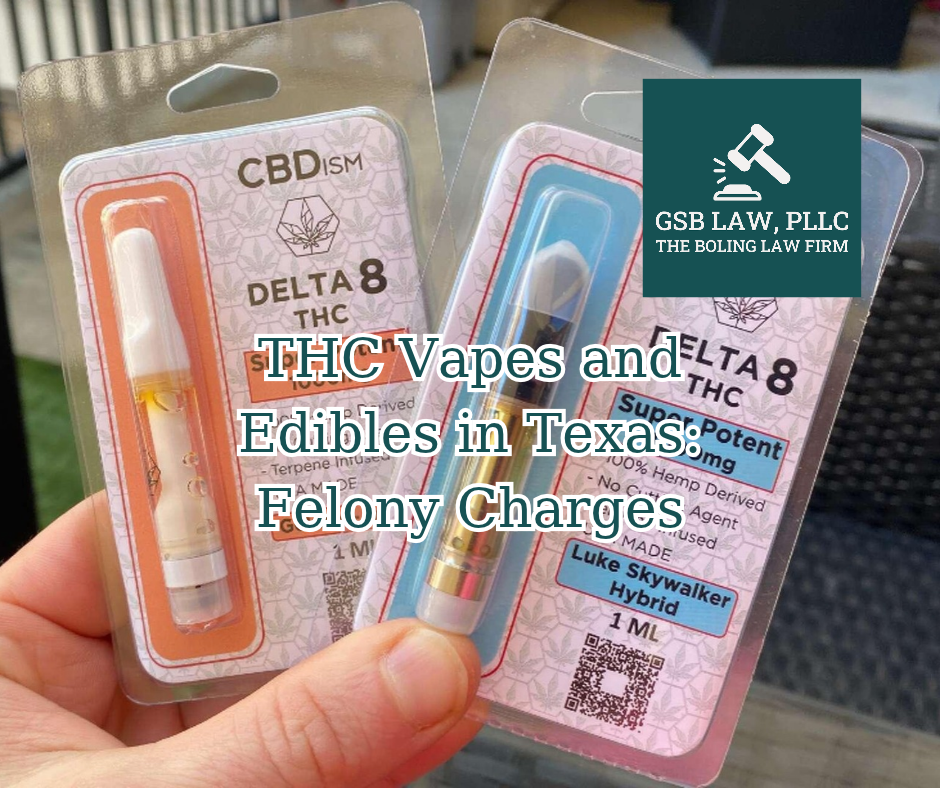
A THC vape cartridge or package of cannabis edibles may seem like a minor possession issue, especially to someone familiar with marijuana laws in other states. In Texas, however, possessing certain THC concentrates can result in felony drug charges, even when the amount is small. For college students, working professionals, and parents throughout Denton, Collin, and Tarrant counties, understanding this distinction can make an enormous difference when dealing with a criminal investigation or arrest.
Texas law treats marijuana and certain concentrated THC products differently. While possession of a small amount of marijuana generally falls under misdemeanor provisions, possession of a controlled THC concentrate may be prosecuted under the more serious Penalty Group 2 provisions of the Texas Controlled Substances Act. The legal consequences can surprise people who believe that a vape cartridge, gummy, or edible purchased at a retail store must be lawful to possess.
At GSB Law, PLLC, criminal defense attorney Gregory Scott Boling represents individuals facing drug possession allegations in North Texas. Understanding what substance was actually possessed, how it was tested, and how law enforcement calculated its weight can be essential to evaluating a THC-related criminal charge.
Meet Gregory Scott Boling, Your Criminal Defense Attorney
Why THC Vape Cartridges and Edibles Are Treated Differently From Marijuana
Many people think of marijuana possession as a single category of criminal offense. Texas law is more complicated. The state distinguishes between marijuana, certain cannabis extracts, and controlled substances containing tetrahydrocannabinols, commonly known as THC. Depending on the product’s composition and legal classification, the potential penalties can be dramatically different.
Under Texas Health and Safety Code Section 481.116, unauthorized possession of a Penalty Group 2 controlled substance can constitute a felony. Certain THC concentrates, oils, and edible products may fall within this classification. However, not every product marketed as containing THC automatically qualifies as an illegal Penalty Group 2 substance. The product’s chemical composition, applicable hemp exemptions, and laboratory findings matter.
Consider the difference between someone possessing a small quantity of marijuana flower and someone possessing a vape cartridge containing an illegal THC concentrate. Although both individuals might view their conduct as essentially the same, the criminal charges can be substantially different. A possession case involving a controlled THC concentrate may begin at the felony level, while a comparable case involving a small amount of marijuana may be charged as a misdemeanor.
This distinction is particularly important in communities such as Denton, where students attending the University of North Texas and Texas Woman’s University may encounter cannabis products marketed in ways that make them appear ordinary or legally permissible.
How Much THC Does It Take to Become a Felony in Texas?
One of the most surprising aspects of Texas drug law is that a very small quantity of a Penalty Group 2 controlled substance can support a felony charge. Under Section 481.116, the potential offense level depends on the aggregate weight of the controlled substance, including applicable adulterants or dilutants.
The statutory punishment categories include:
- Less than one gram: State jail felony.
- One gram to less than four grams: Third-degree felony.
- Four grams to less than 400 grams: Second-degree felony.
- 400 grams or more: First-degree felony, with enhanced statutory punishment provisions.
These categories illustrate why an arrest involving a small THC concentrate can be much more serious than the person initially expects. Even a state jail felony conviction can carry significant consequences, including possible confinement, fines, and a criminal record that affects future opportunities.
Importantly, these weight categories apply when the substance is legally classified within Penalty Group 2. They should not be interpreted to mean that every vape cartridge or package of hemp-derived gummies automatically constitutes a felony.
Why the Weight of a Vape Cartridge or Edible Matters
People often assume that drug possession charges are based exclusively on the amount of THC contained in a product. Under Texas law, however, the calculation for Penalty Group 2 substances can include adulterants or dilutants. This distinction can become especially significant when dealing with THC oils, concentrates, or edible products containing multiple ingredients.
For example, a gummy may contain only a relatively small amount of THC compared with its total weight. Nevertheless, depending on the substance’s classification and how the law applies to its ingredients, the weight calculation may be considerably different from what a consumer expects.
That does not mean the entire weight of every edible, cartridge, or container is automatically counted. Whether other ingredients qualify as adulterants or dilutants is a legal and evidentiary question. The weight of unrelated packaging or a vape device should not simply be assumed to be the weight of the controlled substance.
An experienced criminal defense attorney should examine the laboratory results, the physical evidence, and the prosecution’s proposed weight calculation before accepting the offense classification.
What Happens When Police Find a THC Vape During a Traffic Stop?
A traffic stop is one common setting in which THC possession allegations arise. A driver may be stopped for speeding, a registration issue, or another traffic violation. During the encounter, an officer may observe a vape cartridge, smell what appears to be marijuana, or ask questions about substances inside the vehicle.
The discovery of a suspected THC product can lead to additional investigation, a search, seizure of evidence, or an arrest. However, the legality of those actions depends on the specific circumstances. The Fourth Amendment protects individuals against unreasonable searches and seizures, and officers must have an applicable legal justification for their actions.
Possession also involves more than the mere presence of a product inside a vehicle. When several people occupy the same car, questions may arise about who actually possessed or controlled the suspected substance. Prosecutors generally must establish a legally sufficient connection between the accused person and the contraband.
For someone arrested in Denton, Plano, Frisco, McKinney, Fort Worth, or a surrounding community, the details of the traffic stop may become important parts of the defense. Dash camera recordings, body camera footage, officer reports, and laboratory testing can all affect how the case proceeds.
Are Delta-8, Delta-9, and Hemp-Derived THC Products Legal in Texas?
The growth of hemp-derived products has created considerable confusion about what consumers can legally purchase or possess in Texas. Some products are advertised as hemp-derived, federally compliant, or available without a medical prescription. Consumers may reasonably wonder why a product offered for sale could later become the subject of a criminal investigation.
Texas law distinguishes lawful hemp products from controlled substances, but the distinction involves more than the name printed on the package. State regulations address THC concentrations, chemical composition, product testing, labeling, and retail distribution. Texas has also adopted additional restrictions affecting certain cannabinoids and vaping products.
In 2026, Texas authorities clarified the controlled status of delta-8 THC following a Texas Supreme Court decision. The Texas Department of State Health Services has explained that only naturally occurring trace amounts of delta-8 THC in hemp fall within the applicable exemption. Other hemp-product restrictions and regulatory disputes have further complicated the legal landscape.
As a result, consumers should not assume that a product is lawful simply because it was purchased at a convenience store, smoke shop, or online retailer. At the same time, a retail label or an officer’s initial description of a product does not establish every element of a criminal offense.
The actual substance, its laboratory analysis, the governing law, and the circumstances of possession all matter.
Why THC Charges Are Especially Concerning for College Students
Denton is home to major universities, including the University of North Texas and Texas Woman’s University. Students arriving from other states may be accustomed to jurisdictions where recreational marijuana products are legal or where small possession offenses receive different treatment. Others may simply misunderstand the distinction between marijuana flower and concentrated THC products.
A student arrested with a THC vape or edible may face consequences extending well beyond the immediate criminal case. Depending on the circumstances, an arrest or conviction can raise questions involving university disciplinary policies, professional licensing requirements, internships, employment applications, and housing opportunities.
Students preparing for careers in healthcare, education, finance, law enforcement, or other regulated professions may have particular concerns about criminal history and future licensing. The effect of a charge depends on the profession, licensing authority, and ultimate disposition of the case. An arrest does not automatically end a student’s educational or professional future, but ignoring the charge can create unnecessary risks.
Parents who learn that their college-age child has been arrested should also understand that the situation may be more serious than a conventional marijuana possession case. A relatively small quantity of a concentrated substance may expose the student to felony prosecution, making early legal representation especially important.
Can Someone Be Charged With a Felony for THC Gummies?
Yes. Possession of gummies containing an illegal Penalty Group 2 controlled substance can potentially result in felony charges under Texas law. The relevant question is not simply whether the product is a gummy, candy, or other edible. The prosecution must establish that the product contains a controlled substance and that the applicable statutory requirements are satisfied.
Edible cases can raise significant questions concerning laboratory testing, the identification of THC compounds, and the weight attributed to the alleged controlled substance. They may also involve products that are marketed as hemp-derived, making the legal classification especially important.
Consider a person who purchases a package of gummies believing the product is lawful because it was available at a retail business. If the gummies are later seized during a police encounter, the person may be surprised to learn that law enforcement suspects the product contains an illegal controlled substance.
The fact that someone purchased a product at a store does not automatically provide a complete defense. Nevertheless, the circumstances of the purchase, product labeling, laboratory evidence, and the person’s knowledge may all warrant examination by defense counsel.
What Prosecutors Must Prove in a Texas THC Possession Case
An arrest is not a conviction. In a prosecution for possession of a Penalty Group 2 controlled substance, the state must prove the elements of the charged offense beyond a reasonable doubt.
That generally includes establishing that the accused knowingly or intentionally possessed the controlled substance. The state must also prove the substance’s legal classification and the quantity necessary to support the charged offense level.
These requirements can create several important areas for defense investigation. For example, an attorney may examine whether the accused actually exercised care, custody, control, or management over the substance, particularly when drugs were discovered in a shared vehicle or residence.
Other questions may involve whether law enforcement conducted a lawful search, whether the evidence was properly collected and preserved, and whether the laboratory findings support the prosecution’s allegations. A discrepancy between an officer’s initial field assessment and subsequent laboratory testing may also be relevant.
Every case is different. A strong defense begins with examining the evidence rather than assuming that the allegations in an arrest report are necessarily accurate.
Can a First-Time THC Possession Charge Be Dismissed or Reduced?
A first-time arrest does not automatically guarantee dismissal, reduced charges, or probation. However, a person with little or no criminal history may have options worth exploring, depending on the facts, the applicable offense, and the policies of the court and prosecutor.
Potential resolutions may include a negotiated reduction, an eligible diversion program, deferred adjudication community supervision, or dismissal where the evidence or legal circumstances support that outcome. Availability varies by jurisdiction, offense classification, criminal history, and other eligibility requirements.
Denton, Collin, and Tarrant counties do not necessarily handle every drug possession case in the same manner. Local procedures and available programs can differ, making it important to work with counsel familiar with the relevant courts.
For students and young professionals, the long-term effect of the case may be just as important as the immediate punishment. Questions involving eligibility for nondisclosure or expunction should be addressed based on the eventual case disposition and applicable Texas law.
What Should You Do After Being Arrested for THC Possession?
Someone facing a THC possession investigation should take the situation seriously, even when the product involved appears minor. A person should avoid making assumptions about the offense level, the legality of the product, or the likelihood that prosecutors will dismiss the case.
Individuals have constitutional rights, including the right to remain silent and the right to consult an attorney. A person generally should not attempt to explain away a suspected controlled substance through lengthy statements to police without first obtaining legal advice. They should also avoid deleting potentially relevant messages, disposing of evidence, or discussing case details publicly.
Keeping available purchase receipts, product information, packaging records, and other lawful documentation may help an attorney investigate the circumstances. Those materials should be discussed with counsel, who can determine whether they are relevant and how they should be preserved.
Prompt legal representation can also help ensure that important deadlines, court appearances, and opportunities to review the prosecution’s evidence are not overlooked.
Criminal Defense for THC Vape and Edible Charges in Denton, Collin, and Tarrant Counties
Texas drug laws can create serious consequences for people who do not realize that certain THC concentrates are treated differently from marijuana. A vape cartridge or package of edibles may appear insignificant, but the legal classification of the substance can determine whether someone faces a misdemeanor allegation or a felony prosecution.
For college students, parents, and working professionals, the consequences of a THC-related criminal charge can extend into education, employment, licensing, and personal reputation. Understanding the evidence and the available legal options is an important first step toward protecting those interests.
Attorney Gregory Scott Boling of GSB Law, PLLC represents individuals facing criminal charges throughout Denton, Collin, and Tarrant counties. If you or a family member has been arrested or is under investigation for possession of THC vape cartridges, edibles, or other controlled substances, contact GSB Law, PLLC to discuss the circumstances of your case and your legal options.
This article is provided for general educational purposes and does not constitute legal advice. Texas cannabis and hemp laws are subject to regulatory developments and court decisions. The applicable law and available defenses depend on the particular facts of each case.