
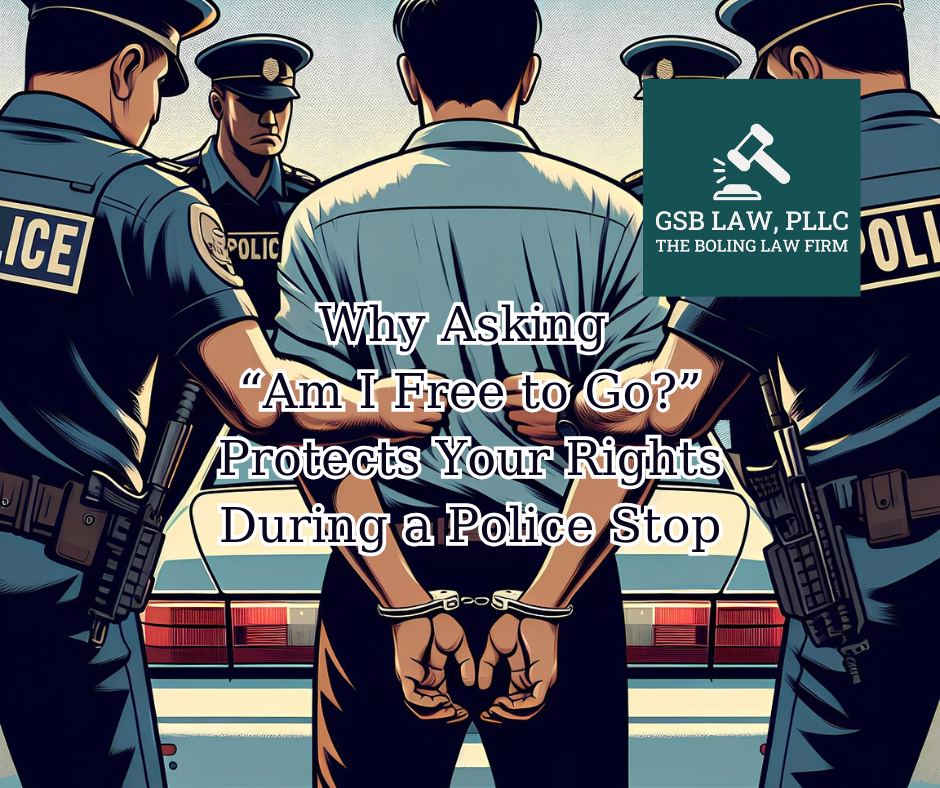
Being stopped by the police, whether while driving, walking, or even standing in a public place, is stressful. For many people in Denton County and across North Texas, it is not always clear what the police can and cannot do. In that uncertainty, people often talk too much, answer questions they do not need to answer, or act nervously in a way that makes the situation worse.
There is, however, one simple phrase that helps you take back some control: “Am I free to go?” Saying these words calmly and clearly forces the officer to make your legal status clear. If the officer says yes, you are free to leave and should walk away. If the officer says no, then you know you are being detained, and that is the moment to stop talking until you have spoken with a lawyer.
This is not a trick or a loophole. It is a practical application of the Constitution and the protections built into the American legal system. Knowing how and when to use this phrase may prevent you from giving up rights you did not even realize you had.
Types of Police Encounters Explained
The law breaks down interactions with law enforcement into three main categories. Understanding the differences will help you know when “Am I free to go?” matters most.
1. Consensual Encounters
A consensual encounter is when a police officer approaches you casually, without any suspicion that you have done something wrong. It may feel intimidating, but you are not under any legal obligation to stay or to answer questions. For example, an officer might walk up to you in a parking lot and start asking where you are headed. At this stage, you are just two people talking.
Unfortunately, many people do not know this and assume they must respond. Asking “Am I free to go?” is the polite way to test whether this is a consensual encounter. If the officer says yes, leave calmly. If the officer tries to keep you there, then it is no longer consensual, and your rights change.
2. Detention
A detention happens when an officer has reasonable suspicion that you may be involved in a crime. Reasonable suspicion is a legal term that means the officer has specific and explainable reasons for stopping you, but not enough proof to arrest you. For example, if your car matches the description of one seen leaving a burglary, or if you are seen in an area where drugs are frequently sold, the officer may stop you briefly to ask questions.
During a detention, you are not free to leave, but you are also not under arrest. This is the most critical moment to exercise your right to remain silent. Even if the officer insists they just want to “hear your side of the story,” talking often gives them more information than you realize.
3. Arrest
An arrest requires probable cause, which means stronger evidence exists that you committed a crime. At this point, you may be placed in handcuffs and transported to jail. Anything you say after being arrested can and will be used in court. If you have already asked “Am I free to go?” and the answer was no, you now know you are in custody. The smartest thing you can do at this point is remain silent until you speak with your lawyer.
Why Silence is Your Best Defense
The U.S. Constitution, specifically the Fifth Amendment, gives you the right to remain silent. This is not just a television cliché from crime shows. It is a powerful tool to prevent self-incrimination.
Talking to police often feels like the natural thing to do. People want to explain themselves or clear up a misunderstanding. The problem is that even innocent comments can be twisted, misremembered, or taken out of context. For example, if you say you were “just driving home from a friend’s house,” the police may use that to check for alcohol, question your friend, or look for other angles. By staying silent, you avoid creating problems that did not exist before.
Practical Steps If You Are Stopped
Here is a clear, step-by-step guide to follow if you are stopped by police in Denton County or anywhere else in Texas:
- Stay Calm and Respectful. Do not raise your voice or act aggressively. Nervousness is normal, but hostility can escalate the situation.
- Ask, “Am I free to go?” Say it clearly and calmly. This puts the officer on the spot to clarify whether the encounter is voluntary or a detention.
- If the Answer is Yes, Leave. Walk away quietly without adding extra comments. Do not linger or try to “make small talk.”
- If the Answer is No, Remain Silent. At that point, you are being detained. You must provide identification if asked, but beyond that, you should not answer questions about where you are going, what you are doing, or anything related to an investigation.
- Request a Lawyer. Say, “I do not wish to answer questions without a lawyer.” After that, stop talking. Even continuing a casual conversation could hurt you later.
- Contact The Boling Law Firm as Soon as Possible. The faster an experienced lawyer is involved, the better your chances of protecting your record, your rights, and your future.
Everyday Examples
It may help to imagine some real-world situations. Suppose you are pulled over in Denton on Loop 288 because your car has a broken taillight. The officer starts asking where you are coming from, whether you have been drinking, and who is in the car with you. This feels like small talk, but these are investigative questions designed to gather evidence. If you ask, “Am I free to go?” and the officer says yes, you can leave after your warning or citation. If the officer says no, then it is clear you are being detained, and silence is the right move.
Or picture a young college student in downtown Denton who is approached on foot by an officer asking if they have seen any drugs in the area. The student feels pressured to answer, but it is a consensual encounter. “Am I free to go?” allows the student to end the conversation without risk.
Why You Need a Lawyer After a Stop
Even if you handle yourself perfectly, a stop can still lead to charges. Officers may claim they smelled marijuana, thought you were intoxicated, or suspected other wrongdoing. Once you are in the legal system, it moves quickly and can be overwhelming.
That is where an attorney comes in. A lawyer knows how to challenge the stop itself, question whether there was really reasonable suspicion, and fight against improper searches or statements. Without a lawyer, you are on your own against trained prosecutors and police officers who handle these cases every day.
Why Choose The Boling Law Firm
Attorney Gregory Scott Boling has years of experience representing clients in Denton, Collin, and Tarrant Counties. He understands how North Texas law enforcement works and how prosecutors try to build cases. His mission is to protect his clients’ rights and fight for the best outcome possible.
Whether it is a simple traffic stop that escalated, a DWI arrest, or a more serious charge, you do not have to face the situation alone. The Boling Law Firm, GSB Law PLLC, provides personal attention, strong defense strategies, and a commitment to protecting your future.
Take Control of Your Rights
Knowing how to ask “Am I free to go?” can mean the difference between walking away and being pulled deeper into the legal system. It clarifies your status, keeps you from volunteering harmful information, and activates your right to remain silent.If you or someone you love has been stopped, detained, or arrested, call The Boling Law Firm in Denton immediately. Serving Denton, Collin, and Tarrant Counties, Attorney Gregory Scott Boling is ready to defend your rights and your future.